
Purpose Before Profit: Maggie Keith Of Foxhollow Farm On The Benefits Of Running A Purpose-Driven Business
An Interview With Chad Silverstein
At the end of the day, I don’t separate purpose from business. The purpose is the business. It’s about creating something that sustains the land, supports people, and leaves things better for the next generation.
As a part of our series, we had the pleasure to interview Maggie Keith.
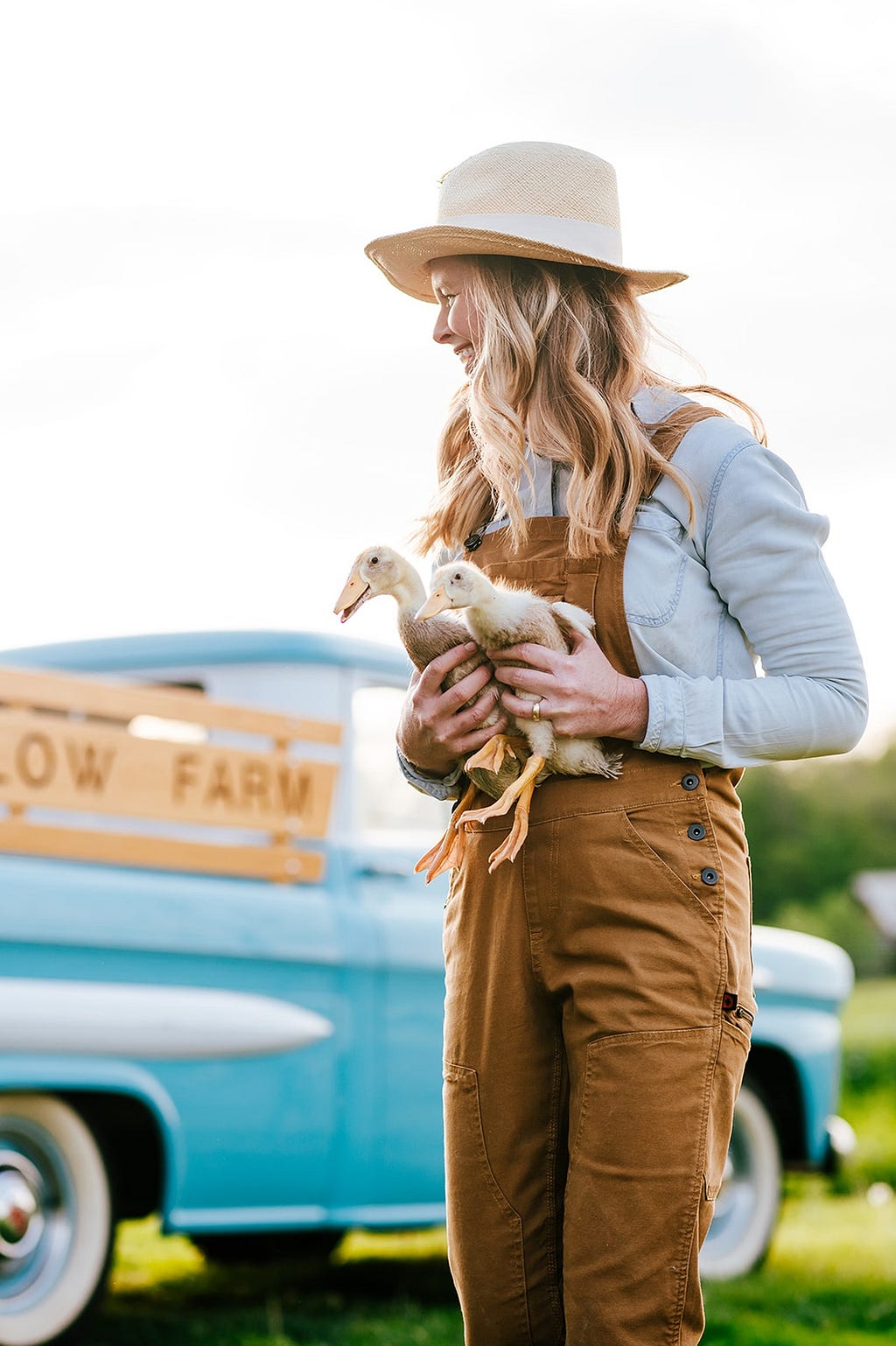
Maggie Keith is a fourth-generation steward of Foxhollow Farm, a 1,300-acre Biodynamic farm community in Crestwood, Kentucky. Over the past 20 years, alongside her mother and a committed team, she helped transition the land from a conventional three-crop rotation to a regenerative, cattle-based system, now raising 100% grass-fed and finished beef and supporting a community of farmers and land stewards. She is passionate about rebuilding regional food systems and helping people know their farmer and their food. Maggie is also the co-creator and co-host of the PBS series The Farmer and The Foodie, now in its sixth season, where she shares stories from the land and the people who care for it. She lives on Foxhollow Farm with her husband and three children. Motherhood deeply shapes her work, grounding her in a long-term commitment to caring for the land and future generations.
Thank you so much for joining us in this interview series! Our readers would love to get to know you a bit better. Can you tell us your “Origin Story”? Can you tell us the story of how you grew up?
I’m a fourth-generation steward of a 1,300-acre family farm, though my family isn’t made up of farmers in the traditional sense; we’re agrarians, rooted in a deep relationship with the land. My great aunt Margaret spent her days in the apple orchard and open pastures of the dairy farm she stewarded. My grandmother Mary wandered fields of wildflowers tucked into a protected valley near her homeplace. And my mother, Janey, got lost in the woodlands, hiding tiny pebbles beneath fairy umbrellas and climbing the staircase waterfall along Harrods Creek.
I didn’t grow up on the farm; I grew up in the city of Louisville, but I was always drawn outside. Some of my earliest memories are of visiting Foxhollow with my mother and my two older brothers, exploring the woods around my grandmother’s home. Somewhere along the way, either my mother or my grandmother placed Wendell Berry’s novels and poetry in my hands. I remember feeling a deep longing for the kind of family, purpose, and connection to land that his stories spoke to. That sense of longing and belonging has shaped the path I’m on today.
Can you share the most interesting story that happened to you since you began leading your company or organization?
One of the more unexpected chapters in my work has been co-hosting a PBS television show about good food and farming. For six seasons, we were able to bring the stories of regenerative agriculture into people’s living rooms across the country. It gave us a platform to show what farming can look like when the goal isn’t just production, but healing the land and rebuilding relationships between farmers and the people who eat their food.
What really stayed with me, though, were the moments out on the road, visiting generational farmers across rural Kentucky. So many times I’d find myself thinking, I can’t believe this is my job, standing in someone’s pasture, listening to their story, learning from the way they care for their land. And then we’d gather around a table, and the conversation would continue over a shared meal. It reminded me again and again how powerful food can be, not just to nourish us, but to connect us, even across differences.
We often learn the most from our mistakes. Can you share one that you made that turned out to be one of the most valuable lessons you’ve learned?
One of the most valuable lessons I’ve learned came from not putting strong financial and operational systems in place early enough as we grew. For a long time, I was leading from vision, relationships, and momentum, but without the backend clarity to match it. It caught up with us. What I’ve learned is that good farming and good business both require stewardship. Today, I think about financials, data, and operations as another form of land care. It’s not separate from the mission; it’s what allows the mission to endure.
As a successful leader, it’s clear that you uphold strong core values. I’m curious what the most important principles you firmly stand by and refuse to compromise on. Can you share a few of them and explain why they hold such significance for you in your work and life?
For me, it starts with the soil. If the soil isn’t healthy, nothing else works, not the food, not the animals, not the people eating it. That’s why I’m so committed to regenerative and Biodynamic farming. You have to treat the land as a living system and steward it with care, not extract from it.
I also won’t compromise on transparency. People deserve to know where their food comes from, how it was raised, and who raised it. Selling directly to consumers matters to me because it rebuilds that trust that’s been lost in the industrial food system, it creates a real relationship again between farmer and eater.
And finally, I believe farming should support farmers, not push them out. A healthy food system depends on real farms staying on the land, and on the next generation seeing a viable path into agriculture. If we lose that, we lose something much bigger than just food; we lose connection, culture, and stewardship.
What inspired you to start a purpose-driven business rather than a traditional for-profit enterprise? Can you share a personal story or experience that led you to prioritize social impact in your business?
For me, it never felt like a choice between a purpose-driven business and a traditional one; it was always the same. I grew up with a strong sense that what we do should contribute to something beyond ourselves. My grandmother would take me to volunteer at our local food bank, as well as women and children’s shelters and orphanages, and those experiences stayed with me. They instilled in me a deep belief that we all have a responsibility to give back, and that shaped how I think about business.
When I stepped into stewarding Foxhollow, it felt clear that farming couldn’t just be about production or profit. It had to be about caring for the land, nourishing people well, and supporting a system that allows farmers and communities to thrive. Food touches everything: health, environment, economy, culture, so the way we farm matters.
At the end of the day, I don’t separate purpose from business. The purpose is the business. It’s about creating something that sustains the land, supports people, and leaves things better for the next generation.
Can you help articulate a few of the benefits of leading a purpose-driven business rather than a standard “plain vanilla” business?
One of the biggest benefits of leading a purpose-driven business is that it gives you clarity. When your work is grounded in something bigger than just profit, the decisions get simpler. At Foxhollow, we’re not just selling beef; we’re restoring soil, raising animals well, and rebuilding the relationship between farmers and the people eating the food. That purpose shapes everything.
I also love that it allows for creativity and pivoting. Agriculture, food, and hospitality naturally open the door to creating experiences, whether it’s a farm tour, a shared meal, or a hike, that can genuinely shift how people see food and farming. You’re not stuck in one lane; you’re constantly finding new ways to connect people to the land.
Purpose also builds trust. People want to know where their food comes from and how it’s raised. When you’re transparent and values-driven, they feel that. They’re not just buying a product, they’re supporting something they believe in.
And honestly, purpose is what carries you through the hard seasons. Farming has plenty of them. If the goal were only profit, it would be hard to stay in it. But when the mission is bigger, healing land, feeding people well, supporting farmers, you stay committed, even when it’s not easy.
How has your company’s mission or purpose affected its overall success? Can you explain the methods or metrics you use to evaluate the impact of this purpose-driven strategy on your organization?
For us, our mission isn’t separate from our success; it defines it.
One way that shows up is in our direct relationship with customers. We sell beef directly to households that care deeply about how their food is raised, and that relationship is built on trust and transparency. The number of subscribers and returning customers is our clearest metric, people choosing to stay connected to the farm over time.
Another measure is the health of the land itself. We’re Level 5 Regenified certified, the highest level, along with Biodynamic and AGA certifications. Regenerative farming is about rebuilding soil, increasing biodiversity, and healing ecosystems, so we look at the condition of the land as a core indicator of success, not just financial performance.
And we also measure whether the farm is supporting people. Foxhollow operates as a farm community, with multiple farmers and businesses working on the land. Part of our mission is creating a place where farming can be a viable livelihood. So we look at how many people are building businesses here, stewarding the land alongside us, and how many people come to experience the farm through events and education.
At the end of the day, we’re measuring success across three areas: healthy land, strong relationships with customers, and a thriving community around the farm.
Can you share a pivotal moment when you realized that leading your purpose-driven company was actually making a significant impact? Can you share a specific example or story that deeply resonated with you personally?
One moment that really stayed with me was a collaboration we did with Maker’s Mark, bringing a group of women in the bourbon industry to Foxhollow for a regenerative farming experience. It was incredible to partner with their team; their strength in storytelling and experiential marketing elevated the whole experience and helped translate what we do on the farm in a really powerful way.
What struck me most, though, was what happened after the tour. Several women came up to me and started sharing personal stories, memories of grandparents’ farms, childhoods spent outdoors, connections to land they hadn’t thought about in years. Others told me they were going to start making more intentional choices about where they source their food, especially the meat they feed their families and serve to friends.
That’s when it really clicked for me that the impact isn’t just in the farming, it’s in the storytelling and the experience. When people can see and feel how food is raised, it shifts something. They don’t just learn, they carry it with them, and it changes how they show up in the food system. That ripple effect is where real change begins.
Have you ever faced a situation where your commitment to your purpose and creating a positive social impact clashed with the profitability of your business? Have you ever been challenged by anyone on your team or had to make a tough decision that had a significant impact on finances? If so, how did you address and reconcile this conflict?
Yes, and honestly, that tension comes up more often than people might think.
We used to host a Fall Festival that grew really big, up to 10,000 people. It became a beloved tradition. Families came year after year, and I still have people in their 20s tell me how much those memories meant to them growing up. But over time, it became clear that the scale of it was taking a toll on the land. Parking alone was tearing up our pastures, and the cleanup and recovery weren’t aligned with the kind of farming we say we believe in. It wasn’t regenerative, it was extractive.
I had to really challenge my own decision-making. On paper, it made sense financially, and emotionally, it was hard to even consider changing something that meant so much to people. But at the end of the day, I couldn’t justify compromising the land for the sake of an event, no matter how loved it was.
We decided to shift to more curated experiences, smaller gatherings of 12–24 people, and a handful of larger concerts capped at around 1,000 people. Experiences that feel aligned with the land instead of working against it. It wasn’t easy, and there were real financial implications. But I wasn’t alone in it. Our Head Herdsman, Derek, spoke up about the impact on the pastures and stood firmly in protecting the land. Having that kind of alignment and conviction on the team mattered.
That experience reinforced something for me: if you’re truly purpose-driven, you have to be willing to make decisions that protect the integrity of that purpose, even when they’re hard, even when they cost you something.
What advice would you give to budding entrepreneurs who wish to start a purpose-driven business?
Purpose has to be real. If it’s just a marketing message, people will feel that quickly. The work itself has to reflect the values you’re talking about.
It’s also important to think in the long term. Land, food systems, and communities don’t change overnight. The impact of purpose-driven work often shows up over years, not months.
And I would say stay connected to the people your work is meant to serve. In agriculture, that means farmers and eaters. When you stay close to those relationships, it keeps the mission grounded in reality instead of theory.
What are your “5 Things You Need To Create A Highly Successful Purpose-Driven Business”?
1. A clear mission that actually guides decisions
Your purpose has to show up in the small, daily choices. At Foxhollow, that means we make decisions based on what’s best for the land and the animals, even when it costs more. For example, we give our cattle free-choice minerals and use things like apple cider vinegar as part of their care, rather than cheaper, conventional inputs. It’s a small decision, but it reflects the bigger commitment to raising animals in a way that supports their health and the soil.
2. A willingness to educate your audience
You can’t assume people understand how food is produced; you have to bring them along. When I first stepped into this work in 2006, I had a lot to learn. I spent time with generational farmers, farmers from different cultures, and people all across rural Kentucky. That curiosity shaped everything. Now, whether it’s through The Farmer and The Foodie or on-farm experiences, I see education as part of the work, helping people connect the dots between land, food, and health.
3. Authentic leadership
People can feel when something is real. Our Head Herdsman, Derek Lawson, is an eighth-generation Kentucky farmer with a master’s in forages, and he’s the real deal. He’s not just managing cattle, he’s constantly observing, experimenting, and improving how we care for the land and animals. He also teaches the rest of us along the way. That kind of grounded, lived expertise builds trust internally and externally.
4. A strong community around the mission
This work is too big to do alone. From the beginning, my mom and I knew we wanted Foxhollow to be a farm community. One of our first partner growers was Pavel, who still farms about four acres of vegetables here today. He’s been an incredible partner over the years. That model, multiple farmers stewarding the land together, makes the farm more resilient and keeps the mission bigger than any one person.
5. Patience
Anything tied to land takes time. When I first wrote the business plan in 2006, it was a 20-year vision. We knew this wouldn’t be a quick return; it was about building something that could last for generations. Regenerating soil, building trust with customers, and creating a viable farm economy all take time. But if you’re willing to stay the course, the impact compounds in a really meaningful way.
I’m interested in how you instill a strong sense of connection with your team. How do you nurture a culture where everyone feels connected to your mission? Could you share an example or story that showcases how your purpose has positively influenced or motivated people on your team to contribute?
For me, connection starts with making the mission tangible. At Foxhollow, this isn’t abstract; we’re all working with the land, the animals, and the food every day. When you can see the impact of your work in the soil, in the herd, or on someone’s plate, it naturally creates a deeper sense of purpose.
But we also make space to experience it together. One simple but meaningful example is how we’ve built a culture around actually cooking and eating our beef as a team. We’ll try different cuts, share photos of meals we’ve made, swap cooking tips, and even create beef cut flashcards so everyone, from operations to marketing, really understands what we’re selling. We often share meals at ops meetings made with our beef, and we talk about flavor, what worked, and what didn’t. That piece, flavor, is key. It connects everyone back to why this work matters.
Foxhollow also operates as a farm community, with multiple farmers and collaborators stewarding the same land. That creates a shared sense of responsibility and pride. People aren’t just doing a job; they’re part of something living and evolving.
I’ve found that when people can taste it, see it, and experience it firsthand, they don’t need to be told why the mission matters; they feel it.
Imagine we’re sitting down together two years from now, looking back at your company’s last 24 months. What specific accomplishments would have to happen for you to be happy with your progress?
Looking ahead, success for me is grounded in both the health of the land and building a healthy, replicable business model.
The land continues to improve, soil health, biodiversity, and the number of farmers and collaborators successfully stewarding it are all moving in the right direction.
At the same time, we’re seeing meaningful growth in demand for grass-fed and finished beef, with more consumers choosing products that support regenerative practices and regional food systems.
If those trends continue, strong operations, a healthy, replicable business model, aligned growth, and measurable improvements in the land, that’s success.
You are a person of enormous influence. If you could inspire a movement that would bring the most amount of good to the most amount of people, what would that be? You never know what your idea can trigger. 🙂
If I could inspire a movement, it would reconnect people to the land, to their food, and to each other.
We need real systemic change, shifting policies and incentives away from extractive agriculture and toward systems that actually heal the land and nourish people. But I’ve also learned that change doesn’t only happen through policy. It happens through experience.
Lately, I’ve been really inspired by the kind of work Lindsey Winkler is doing, bringing women together to move, breathe, dance, and reconnect with themselves and the earth. There’s something powerful about that. When people feel grounded in their bodies and connected to the land beneath their feet, something shifts. They start to care differently. They make different choices.
So the movement I’d want to be part of is one where people are reconnected to soil, to food, to community. Where we gather, we share meals, we breathe, we dance, we learn, and we remember that we’re part of nature, not separate from it. Because when that connection is restored, everything else, how we farm, how we eat, how we care for each other, starts to change too.
How can our readers further follow your work or your company online?
Website: https://foxhollow.com
Instagram (Foxhollow Farm): https://www.instagram.com/foxhollowfarmky/
Instagram (Maggie Keith): https://www.instagram.com/frmgirl/
This was great. Thanks for taking the time for us to learn more about us and your business. We wish you continued success!
About The Interviewer: Chad Silverstein is a seasoned entrepreneur with 25+ years of experience as a Founder and CEO. While attending Ohio State University, he launched his first company, Choice Recovery, Inc., a nationally recognized healthcare collection agency — twice ranked the #1 workplace in Ohio. In 2013, he founded [re]start, helping thousands of people find meaningful career opportunities. After selling both companies, Chad shifted his focus to his true passion — leadership. Today, he coaches founders and CEOs at Built to Lead, advises Authority Magazine’s Thought Leader Incubator.
Purpose Before Profit: Maggie Keith Of Foxhollow Farm On The Benefits Of Running A Purpose-Driven… was originally published in Authority Magazine on Medium, where people are continuing the conversation by highlighting and responding to this story.