
An Interview With Chad Silverstein
AI is a force multiplier for the advisor, not a substitute. Advisors who understand and use AI will likely replace the advisors who do not use AI.
In today’s tech-driven world, artificial intelligence has become a key enabler of business success. But the question remains — how can businesses effectively harness AI to address their unique challenges while staying true to ethical principles? To explore this topic further, we are interviewing John O’Connell.
As a part of this series, we had the pleasure to interview John O’Connell.
John O’Connell is founder and CEO of The Oasis Group, an award-winning consultancy and research firm serving wealth management firms nationwide. Founded by O’Connell in 2019, the firm helps RIAs, broker-dealers, family offices, and trust organizations transform their technology, processes, and operations. John has more than 30 years of leadership experience in financial technology and wealth management, including North American leadership at Oracle, fintech CEO and president roles, and participation in IPO and M&A transactions. He is the creator of the AI WealthTech Map (100+ firms), the developer of the Oasis AI Readiness Index, and is recognized as a leading independent voice on AI adoption in wealth management.
Thank you so much for joining us in this interview series. Before we dive into our discussion, our readers would love to “get to know you” a bit better. Can you share with us the backstory about what brought you to your specific career path in AI?
My path to AI is really a natural extension of a career spent at the intersection of finance and technology. I graduated university during the second AI winter. So, I started my career designing and developing financial applications at Merrill Lynch and KPMG Peat Marwick. I’ve been a developer, consumer, implementer, and seller of financial technologies across 30+ years.
I am also a computer gamer. I had a front row seat to the rise of the GPU and Nvidia’s strategy to win over ATI. I knew that the computing power in math processing had laid the foundation for the acceleration of AI capabilities.
I founded The Oasis Group in 2019 to help wealth management and financial technology firms navigate their most complex challenges, and AI quickly became the defining challenge for every firm we work with. I created the AI WealthTech Map — which now tracks over 100 AI firms — because I wanted a rigorous, independent way to evaluate what was actually ready for prime time versus what was just hype. I also invented the AI Readiness Index to enable firms to evaluate their readiness across compliance, training, and technology to leverage AI in their firms.
Can you share the most interesting story that happened to you since you started working with artificial intelligence?
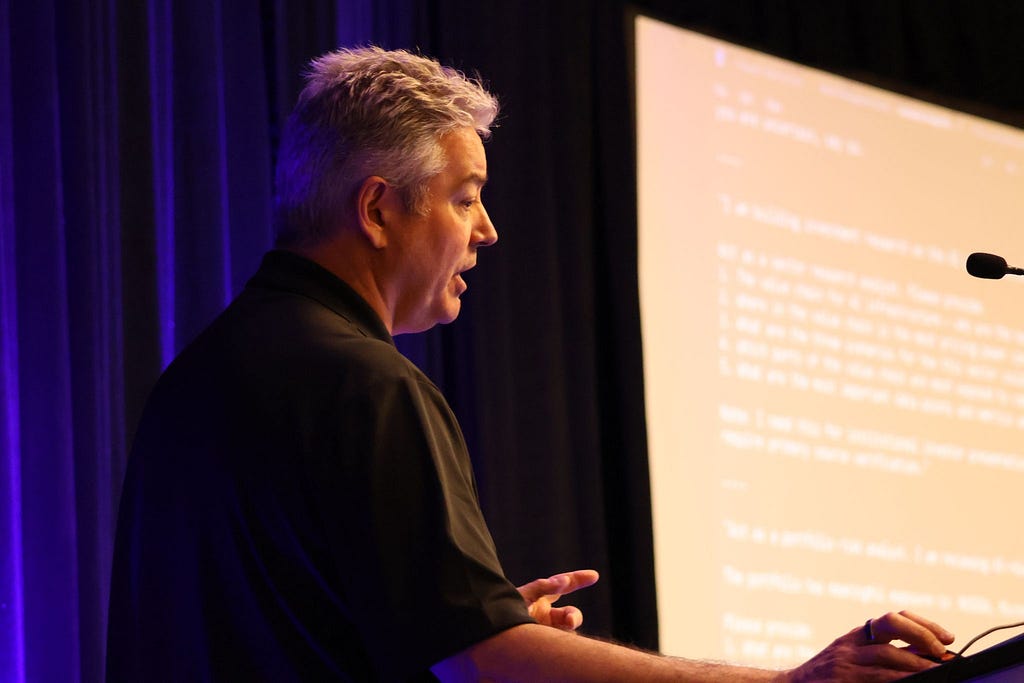
The most interesting moment for me happens repeatedly on stage. When I do live AI demonstrations at major conferences like Schwab IMPACT, T3 Technology Conference, or Financial Planning ADVISE AI, I’ll take a real-world advisor scenario and build a financial plan, draft a client email, or run a Monte Carlo retirement simulation in real time using tools like Claude, ChatGPT, or Perplexity. The room goes quiet as the audience grasps how AI will change our industry. I once used Claude to create a client intake form for a website, gather the data, and then create a financial plan live in 30 minutes for a conference presentation. Advisors who walked in skeptical left that session with a list of use cases they wanted to try the next morning. That transformation from, “this is too complicated” or “this isn’t ready” to “I can actually use this today”, is the most interesting and rewarding experience I’ve had working in AI.
You are a successful leader in the AI space. Which three character traits do you think were most instrumental to your success? Can you please share a story or example for each?
Curiosity. I am a voracious reader. I read prodigiously across my market and adjacent markets because that’s how you spot trends before they become obvious. The firms that got ahead of AI weren’t the ones who waited for their vendors to tell them it was time. They were the ones who were curious enough to explore early. I’ve tried to model that behavior in everything I do at The Oasis Group.
Experimentation. The best way to learn about AI capabilities is experiment with the technology. You need to start with some use cases, generate prompts to solve those use cases with LLMs, and iterate on those prompts to learn better prompting. Then you can begin experimenting with vibe coding, and agents.
Practical rigor. I never recommend something I haven’t personally stress tested. My team doesn’t add a firm to the AI WealthTech Map until we’ve reviewed a demo and confirmed it can add immediate value. When I tell an audience that a tool works, it’s because I’ve put it through its paces on stage, in front of live audiences, with real advisor use cases. There’s no substitute for that.
Let’s jump to the primary focus of our interview. Can you share a specific example of how you or your organization used AI to solve a major business challenge? What was the problem, and how did AI help address it?
One of our most impactful examples involves using AI to accelerate our Peaks Research Series, the in-depth reports we produce to help wealth management firms make more informed technology decisions. Research that used to take weeks of synthesis and writing now takes a fraction of the time, because we use AI as a drafting and analysis partner. The human expertise and judgment remain ours. We’re reviewing demos, conducting interviews, making independent evaluations, but AI handles the heavy lifting of organizing our notes and drafting our initial observations. The result is that we can cover more ground, publish more frequently, and serve our clients better. I’ve also written publicly about using Claude to build a Monte Carlo retirement simulation for Advisor Perspectives, providing specific financial inputs and generating a detailed simulation that demonstrated exactly how AI can make sophisticated financial modeling accessible to any advisor, not just those at firms with large research teams.
What are some of the common misconceptions you’ve encountered about using AI in business? How do you address those misconceptions?
I encounter a few consistently. The first is that AI is not ready yet. That ship has sailed. The tools available today can add immediate value across prospecting, client communications, document management, compliance, and financial planning, and I demonstrate this live at conferences regularly.
The second misconception is that AI will replace advisors. It won’t. The human relationship in wealth management is irreplaceable. AI is a force multiplier for the advisor, not a substitute. Advisors who understand and use AI will likely replace the advisors who do not use AI. AI literate financial advisors will simply move faster with better client intelligence than their counterparts.
The third, and this one concerns me the most, is that AI output can be trusted and deployed without human review. I tell every firm I work with: humans need to stay in the loop. AI notetakers don’t understand sarcasm, they don’t know which conversations are too sensitive to archive, and their output may be subject to legal discovery. You must proofread. The fourth misconception is that you can just start using AI without any guardrails. My research shows that up to 85% of employees at financial firms are already using AI but without a policy. That’s a compliance and security risk hiding in plain sight.
In your opinion, what is the most significant way AI can make a positive impact on businesses today?
The most significant impact is democratization, making high-quality, personalized capabilities available to every business, not just the largest ones. In wealth management, the firms that have historically been able to offer personalized financial advice profitably are the ones serving high-net-worth clients. AI changes that equation entirely. It enables enterprise firms to profitably offer financial advice to emerging wealth clients, segments they could never serve cost-effectively before. AI can automate know-your-customer processes, account surveillance, and compliance reviews, identify patterns to reduce money laundering risks, and enable large language models to power copilot capabilities that allow advisors to deliver personalized advice at scale. That’s a massive expansion of access, and it benefits clients, firms, and the broader financial ecosystem.
Ok, let’s dive deeper. Based on your experience and research, can you please share “5 Ways AI Can Solve Complex Business Problems”? These can be strategies, insights, or tools that companies can use to make the most of AI in addressing their challenges. If possible, please share examples or stories for each.
1. Automating repetitive workflows
Many financial advisors start their day with the same tasks, preparing for client meetings has the same activities — these are just two of many tasks that are repetitive in a wealth manager’s day. Progressive firms are reviewing these workflows as opportunities to leverage AI and drive scale by reducing the hours spent by team members on these tasks.
2. Supercharging client communications
AI writing assistants help advisors produce personalized, compliant communications at scale — from prospect outreach to meeting follow-ups to annual review summaries. What used to take an hour can take minutes, and the quality is consistently high when advisors learn to prompt effectively.
3. Democratizing sophisticated financial analysis
Tools like Claude and Microsoft CoPilot can generate detailed financial plans, Monte Carlo simulations, and investment research summaries in real time. This puts capabilities that were once exclusive to large firms with big research budgets into the hands of independent advisors.
4. Improving technology selection decisions
AI can accelerate and sharpen the vendor evaluation process — helping firms build better requirements, screen vendors faster, and avoid costly technology mistakes. We use AI in our own research process at The Oasis Group to cover more ground and serve clients better.
5. Enhancing cybersecurity defenses
AI is a double-edged sword here because threat actors are using deep fakes and large language models to execute more sophisticated attacks. But defenders can use AI equally well to monitor for threats, detect anomalies, and respond faster. Firms that understand this and invest accordingly will be significantly more resilient.
How can smaller businesses or startups, with limited budgets, begin to integrate AI into their operations effectively?
Start simple and start today. Don’t wait for the perfect enterprise solution. The off-the-shelf tools like Claude, ChatGPT, and Microsoft CoPilot are accessible, affordable, and immediately useful. Before you spend a dollar on an enterprise platform, spend time learning how to write effective prompts. LLMs will literally teach you how to prompt it more effectively right within the tool. Then ask your team what they’d want AI to help with. Chances are they’ve already been thinking about it, and some of them may already be using AI on their own. That leads to the second thing every firm needs to do regardless of size: write an acceptable AI use policy. Make it simple, make it practical, cover the compliance and security basics, and make it clear to your team that you support responsible AI use. Then pick one or two use cases, run a structured pilot, measure results, and build from there. The mistake is trying to boil the ocean. As I tell the audiences I speak to: if you don’t know where the finish line is, don’t start the race.
What advice would you give to business leaders who are hesitant to adopt AI because of fear, misconceptions, or lack of understanding?
The math is simple: we’re producing more new millionaires every year than almost any country on earth, and we’re simultaneously staring down a financial advisor shortage. Demand is growing. Talent isn’t keeping pace. Hesitancy isn’t caution, it’s falling behind on a problem that’s already here.
Separate fear from risk. Compliance concerns and data security are legitimate risks worth managing carefully. “I don’t fully understand it yet” is a training problem, not a reason to wait. Remember that AI does not replace team members, it gives them leverage. More clients served, deeper relationships, less time on manual work.
The leaders I worry about aren’t the skeptics. Healthy skepticism is good business. The ones I worry about are the ones who’ve made peace with doing nothing.
In your opinion, how will AI continue to shape the business world over the next 5–10 years? Are there any trends or emerging innovations you’re particularly excited about?
The most significant disruptions to wealth management and financial services over the next five years will be led by AI adoption and cybersecurity. AI is an immense force multiplier for firms that learn to use it well. We’re already seeing it in note-taking and meeting analysis. The next wave will be AI copilots that allow advisors to deliver truly personalized advice at scale, grounded in their firm’s perspective, aligned to individual client needs. Large language models will make this possible in ways that simply weren’t feasible before. On the cybersecurity side, the threat landscape is evolving just as fast. Deep fakes and AI-driven social engineering are already being weaponized against wealth management firms. Firms that don’t invest in defensive capabilities will be increasingly exposed. The next 5–10 years will separate the firms that treated AI as a strategic priority from those that treated it as a feature on a vendor roadmap.
How do you think the use of AI to solve business problems influences relationships with customers, employees, and the broader community?
When done right, AI deepens relationships rather than weakening them. For clients, it means advisors can show up more prepared, more personalized, and more responsive. For employees, it means less time on low-value administrative work and more time on the work that requires human judgment and empathy. That said, I’m clear-eyed about the risks. Some client conversations are so personal and confidential that they should never be captured by an AI note-taker. Advisors need to use judgment about when the tool should be off. And written AI-generated notes may be subject to discovery in litigation, that’s not hypothetical, that’s real. The firms that navigate this well are the ones that treat AI as a tool that amplifies their people, not one that replaces their judgment.
You are a person of great influence. If you could start a movement that would bring the most amount of good to the most amount of people through AI, what would that be? You never know what your idea can trigger. 🙂
AI will transform the human race as impactfully as the Renaissance and Industrial Revolution. Imagine a world where AI provides better advice to people in need. That can include mental health support in the middle of the night when someone cannot reach their therapist by reminding them of how they are loved. That can include financial advice to millions of families who are accumulating their wealth and not working with a financial advisor yet. That can include hundreds of millions of students who can learn new skills using personalized training plans made specifically for them. AI can recognize patterns better and earlier than humans to diagnose disease earlier and save lives.
I would like to channel the AI revolution into wealth management to enable advisors to provide better and more advice to people who need access to financial advice. I hope that my firm can help thousands of wealth managers to bring their expertise to every family that can benefit from their advice and I plan to leverage AI to help them.
How can our readers further follow you online?
We publish a plethora of articles, white papers, research reports, and other helpful tools for professionals in the financial services industry on the Insights page of our website, www.TheOasisGrp.com. Make sure to follow my personal LinkedIn profile, as well as The Oasis Group’s LinkedIn page, for additional resources.
This was great. Thank you so much for the time you spent sharing with us.
Thank you for having me!
About The Interviewer: Chad Silverstein is a seasoned entrepreneur with 25+ years of experience as a Founder and CEO. While attending Ohio State University, he launched his first company, Choice Recovery, Inc., a nationally recognized healthcare collection agency — twice ranked the #1 workplace in Ohio. In 2013, he founded [re]start, helping thousands of people find meaningful career opportunities. After selling both companies, Chad shifted his focus to his true passion — leadership. Today, he coaches founders and CEOs at Built to Lead, advises Authority Magazine’s Thought Leader Incubator.
John O’Connell of The Oasis Group On How Artificial Intelligence Can Solve Business Problems was originally published in Authority Magazine on Medium, where people are continuing the conversation by highlighting and responding to this story.