
Purpose Before Profit: Erin Lewellen Of Tilting Futures On The Benefits Of Running A Purpose-Driven Business
An Interview With Chad Silverstein
The pandemic forced us to mute the noise and lead from our values. We found out that when you do that, your team becomes unstoppable.
In today’s competitive business landscape, the race for profits often takes center stage. However, there are some leaders who also prioritize a mission-driven purpose. They use their business to make a positive social impact and recognize that success isn’t only about making money. In this interview series, we are talking with some of these distinct leaders and I had the pleasure of interviewing Erin Lewellen.
As CEO, Erin is leading Tilting Futures into a new era of innovation and impact, having founded its flagship Take Action Lab and launched a systems change strategy that integrates immersive, credit-bearing global learning into higher education. A recognized thought leader in youth development and global education, she centers young people’s voices while fostering a culture of equity and inclusion that has earned national workplace recognition. Prior to joining Tilting Futures in 2014, Erin held leadership roles at Revolution Foods and Playworks, served on multiple nonprofit boards, and regularly contributed to major publications including Forbes, Fast Company, Bloomberg, and NBC.
Thank you so much for joining us in this interview series! Our readers would love to get to know you a bit better. Can you tell us your “Origin Story”? Can you tell us the story of how you grew up?
I grew up in Cedar Flat, Oregon, an unincorporated area in rural Oregon. My dad, grandpa, and great-grandpa were all loggers. My mom was a teacher. I had an idyllic childhood by all measures. I also wondered what else was out in the world, how other folks lived. Watching my dad work in one of the deadliest jobs on Earth and my mom teach in our public school system shaped a lot of questions for me early on about who holds power, who has access to opportunities, and how far out of reach those opportunities can feel.
I knew I wanted to get out and be part of something bigger, something I couldn’t name. But figuring out how to do that proved difficult.
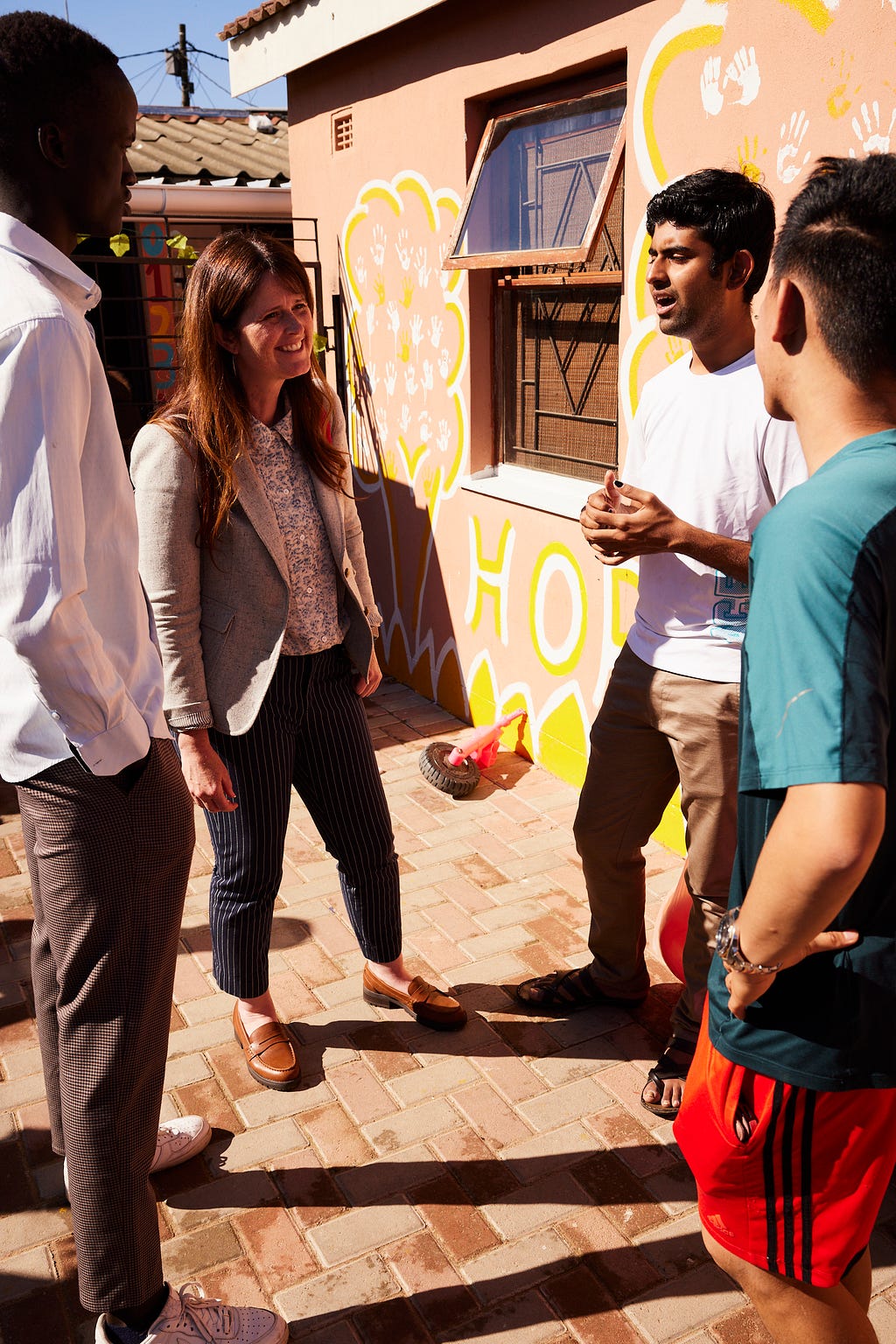
I went to the University of Oregon, which was a first step, it was 30 minutes away. But I knew I needed to go further, somewhere completely apart from anything I knew. I searched for years. Most opportunities I couldn’t afford. Eventually, a donor at the university set up a fund that I could access. That led me to living in my first big city, and interning for a nonprofit combatting domestic violence in Cape Town, South Africa.
That experience changed everything for me. It opened me up to different perspectives, to understanding how people work together across real difference to solve real problems, and how people engage in making their communities better. It also gave me a new sense of courage and deeper curiosities about the world. And it made me think about all the people who never get that. And what it would mean if more young people did.
Can you share the most interesting story that happened to you since you began leading your company or organization?
What comes to mind is the spring of 2020, when I thought evacuating 150 Fellows from four countries — Ecuador, Brazil, Senegal, and India — as the world was shutting down in real time was going to be my hardest leadership moment. We were booking flights that were canceled within minutes of confirmation numbers being issued. Borders were closing. Fellows had lost passports, no viable routes home, parents furious we weren’t moving fast enough, and parents furious we were moving at all. But we got everyone settled. And then the real challenge began.
Once everyone was safe, I had to make a decision that felt even more consequential: cancel our entire fall cohort. It was only April, we still had five months and we had recruited half the upcoming class. But we kept coming back to one question: what do we actually teach our students? To think beyond short-term gains and act toward the greater good. We had been following this for months, and knew it wasn’t going to be over in a few short weeks. So we canceled, before anyone else in our space had moved. By making that call early and communicating it immediately, we bought ourselves something rare in a crisis: time to imagine.
What I didn’t expect was what came next. In four months, with a team that had just been reduced by two-thirds, we went back to our core learning model, to our mission, and built something entirely new. We launched the Academy: a fully rebuilt curriculum, a partnership with a team of researchers at Harvard, and over 200 students from 50 countries in our inaugural class. We went on to serve 1500 students in that model during the darkest days of the pandemic. The pandemic forced us to mute the noise and lead from our values. We found out that when you do that, your team becomes unstoppable.
We often learn the most from our mistakes. Can you share one that you made that turned out to be one of the most valuable lessons you’ve learned?
A leader always needs to consider external stakeholders and constituents when making big decisions, but one of my mistakes is to over index on worrying about external stakeholder opinion. This is a lesson I am still learning. Parents and students were angry when we evacuated them during the pandemic, it was still the right decision. Those same parents came around. We built a new program called Take Action Lab, that many alumni had a negative reaction to because it wasn’t their same experience, and it was still the right thing to do. This has proved itself to be unequivocal and almost all alumni have come around.
When we rebranded and renamed ourselves, we held meetings with all stakeholders to walk them through the process, get their insights as we progressed. Other leaders told me, no matter how well you do this, someone will have an outsized reaction–prepare yourself. When it happened, I was wholly unprepared. Here we were, at a cafe meeting in person for the first time, after many zoom calls. I said the new name out loud, and before I could continue walking the person through it, they exclaimed, I hate it. I paused, they said it again. I hate your new name. Not knowing what to do, I asked them if I could have a moment to walk them through my short presentation for how we got to it, and why we loved it. They said yes, after telling me again how much they hated it. I was rattled. I don’t use the word hate very often, and here it was coming at me over and over again. I was also a relatively new CEO changing the identity of a brand that no longer worked for our mission, it was already nerve wracking! Once I finished walking them through it, their entire demeanor changed. They immediately apologized, said they over reacted, and could understand the name better. And I had to make a choice in that moment, do I take this feedback in, and if so, how? What do I do with it? Again, as someone who is decisive, yet prone to worry and wonder if the call was right, I have to make choices with these moments: what lands and what doesn’t. It’s not easy. Ultimately, the name changed everything for the better, more than we imagined possible. And, it’s another rep on building my muscle to filter through the unnecessary reactive commentary that isn’t useful, and take in the helpful, constructive feedback.
As a successful leader, it’s clear that you uphold strong core values. I’m curious what are the most important principles you firmly stand by and refuse to compromise on. Can you share a few of them and explain why they hold such significance for you in your work and life?
The values that really stand out to me and are also very central to Tilting Futures’ culture are curiosity, empathy, courage, equity and conviction, and they are all interrelated and complement each other.
I think curiosity is fundamental — it’s the foundational spark for all learning and growing. Without it, we become stagnant.
Learning to work across difference is a key component of Tilting Futures’ program, and that means being able to recognize that when we’re working within a community to find solutions to problems, we’re not always going to agree with everyone on everything. We may have significant conflicts. But if we can put ourselves in the place of that other person and try to understand their perspective, we can find areas of agreement and move forward. And that requires empathy.
True learning and growth only happen if we’re open to having our assumptions challenged. We need to be able to have difficult conversations that might shake up our perspectives. And that takes courage. It takes courage to step outside of your comfort zone and experience the unfamiliar. Having tough conversations also requires equity to ensure that all perspectives have an opportunity to be heard and we’re not excluding anyone because their views might conflict with our own.
Finally we need conviction to put ideas into action, and when we form our ideas according to these values, when we’ve arrived at solutions by listening to and understanding diverse perspectives and challenging our own assumptions, the stronger our conviction will be.
What inspired you to start a purpose-driven business rather than a traditional for-profit enterprise? Can you share a personal story or experience that led you to prioritize social impact in your business?
It still goes back to my initial experience in Cape Town, and specifically the time period when I was living there. It was 1999, and the transition from apartheid and creation of a new government was still very fresh and at the forefront of everything happening there. It taught me what is possible when citizenry is focused on building what comes next, and the power of that level of engagement. And I wanted to be a part of doing that throughout my life.
This also connects to my upbringing in a rural logging community and experiencing a community disconnected from the centers of power. It made me question who is making the systems, who is getting to make the decisions and who gets to be a part of that process.
Both of those formative experiences played an important role in driving me toward work that is purpose-focused rather than profit-driven.
Can you help articulate a few of the benefits of leading a purpose-driven business rather than a standard “plain vanilla” business?
Purpose-driven work attracts mission-aligned talent. Talk to almost anyone at Tilting Futures and what you’ll find is that they have had a transformative immersive experience that changed their trajectory forever. In fact, some of our team members are alumni of our programs. While at a “plain vanilla” company, employees sometimes struggle to find deeper meaning in their work, that’s not an issue here. Having people who are so passionate about what they’re doing also has a huge impact on things like culture and retention. It’s really hard to manufacture that kind of excitement and mission-alignment even with a stellar onboarding process.
Decision making looks different at Tilting Futures because we’re a purpose-driven organization. Recently, the Senior Leadership Team gathered for a retreat to kick off the budget development process for the new fiscal year and we first sat down and discussed what we want our guiding principles to be. We decided that one of them, for example, would be “Conviction: We prioritize our mission, impact, and the young people we serve while making decisions that protect the long-term financial sustainability required to continue that impact.” So our north star is very clear and that really changes how decisions are made.
How has your company’s mission or purpose affected its overall success? Can you explain the methods or metrics you use to evaluate the impact of this purpose-driven strategy on your organization?
The mission and the success are deeply intertwined for us and purpose drives all of it. One measure of success is knowing that we’re building awareness among students who are motivated for this kind of experience, and over the past three years we’ve seen the number of applicants surpass the prior 14 combined. We’ve served 63% more young people this year than last. So we know we’re reaching more students than before and helping them to have these transformative experiences that will lead them to pursue purpose-driven lives.
Our Measurement, Evaluation, Research, and Learning team also does a great job evaluating the impact of our program. Their research shows a 45 point increase in our students’ comfort with ambiguity, which is a measure of how well they navigate uncertainty and is critical for problem-solving. Our students complete college at nearly double the rate of the national average. And over 90% of our alumni pursue careers in social impact. These are just a few examples of our impact.
We also have very important institutional validation from an accreditation program with The University of Pittsburgh, which is key as we build a national coalition of college and university partners that includes Stanford, Carnegie Mellon, University of Oregon and others.
Can you share a pivotal moment when you realized that leading your purpose-driven company was actually making a significant impact? Can you share a specific example or story that deeply resonated with you personally?
There’s a moment I keep coming back to.
I was visiting our Take Action Lab program in South Africa a few years ago, and a group of us had just sat down for dinner. The students in that particular group were from different parts of the world — the United States, Europe, East Asia, South America and Africa. One of them shared that she had seen something at her apprenticeship that day that unsettled her, a teacher disciplining a student by striking his wrist with a ruler. She was processing aloud to the group.
What I watched unfold at that dinner table has stayed with me ever since because it exemplifies exactly why we do this work.
Some of the students were horrified. They said that would never happen where they were from. But others around the table said “wait, you’ve never experienced “the stick”? One student even incredulously asked “how can anyone even be motivated without the stick?”. For these students, they saw it as a valuable tool in how they were educated and attributed their success, at least in part, to that form of discipline.
And instead of the conversation collapsing, instead of judgement taking over, something else happened. I watched them sit with the discomfort, and ask real questions. No one walked away having “won” the argument, instead they walked away with the understanding that whatever their pre-conceived idea of what is right and wrong in this situation, based on their own background, was not universally shared.
That’s exactly how our model is supposed to work: it’s not about agreement or the erasure of the values we grew up with and choose to uphold or our background and lived experiences. It’s about building the capacity to stay at the table, even when the conversations get hard. To understand that your truth and someone else’s truth can both be real and the ability to hold that tension is one of the most important skills a person can develop.
Have you ever faced a situation where your commitment to your purpose and creating a positive social impact clashed with the profitability in your business? Have you ever been challenged by anyone on your team or have to make a tough decision that had a significant impact on finances? If so, how did you address and reconcile this conflict?
People want to join the Tilting Futures team because they believe in the work and the opportunity it creates for students. They’re drawn to the mission but not necessarily the business end of what is required for an organization to be sustainable and maximize its impact.
We had a situation several years ago where we set a goal of doubling the number of students we serve while delivering the same high quality programming, but doing so within the budget we had at the time. And that created tension because in reality it meant we had to make tough decisions regarding staffing and other significant structural changes to the organization.
Our reasons were mission-aligned, but no one likes making decisions like that and it wasn’t easy. But at the end of the day you reconcile that with the knowledge that we achieved our goal of providing these opportunities for twice the number of students than we were before.
What advice would you give to budding entrepreneurs who wish to start a purpose-driven business?
When doing this work, there is the what and the how. The what is the impact you aim to create. The how is the method of achieving that impact. Hold close the what, but hold loosely the how. What that means is that people set out to solve a problem (the what) and they design a way they think they can address it (the how). Successful entrepreneurs typically have some level of success in that first iteration, but that doesn’t mean they way they achieved that success will hold when they replicate, or when they grow. But there can be a tendency to insist “the how” must not change. People get attached to the original plan.
I would want a budding entrepreneur to understand that their original plan will need to morph and adapt to different circumstances. You have to be open to learning new ways of doing things. I’ve never met any successful entrepreneur whose original idea for “the how” stayed intact over time.
What are your “5 Things You Need To Create A Highly Successful Purpose-Driven Business.”
1. Bring the Magic
When you’re new or small, you can’t afford to be a 7 out of 10. People are taking a risk by trying something unfamiliar, and the only way to earn their trust, and their word-of-mouth, is to be an 11. Not just good. Undeniably, unforgettably good. When people are genuinely moved by what you’ve created, they tell others not because you asked, but because they can’t help it. That organic momentum is the only sustainable foundation for growth. If you don’t nail the magic early, scaling will only scale the mediocrity.
2. Stay Close to Beneficiaries
It’s easy in the non-profit world to get caught up in the day-to-day work and the relentless focus on fundraising and operational sustainability, but it’s important to maintain a close, active relationship with the people you’re serving or supporting. It keeps you mindful of the ultimate goal of your mission and also helps you stay in touch with their needs that inevitably change over time.
3. Adapt or Die
When I was in AP Biology in high school, I had a teacher who had this phrase printed out using an old dot matrix printer in huge block letters and had it hung over the classroom. Of course it was a reference to Darwinism but it’s also highly relevant to running an organization and making sure your plan to achieve a mission will succeed. It’s remarkable how relevant that feels across so many dimensions of success.
4. Start Small, Make the Unit Economics Work
I’ve been involved with three social enterprises that were focused on growth, and each time we reached a point where the amount we could charge for services versus the amount that it cost for those services were at odds. This goes back to what I said about “the how.” Find a way to make the unit economics work faster and then you’re in a better position to grow. Before the unit economics are right, growing can inch you closer to the fiscal cliff.
5. Take a moment to celebrate success
I’ve been in certain situations where, whether it’s me personally or the organization, there is such a hyper focus on looking ahead to what’s next and how we’re going to get there, that we lose focus on the achievements we’re making and taking stock of them. It’s very important as a leader to acknowledge when the organization has succeeded and celebrate it, and to do so for yourself as well. It affirms that what we’re doing works and motivates everyone to move forward. I am always reminding myself to do this, because it’s so hard to do consistently!
I’m interested in how you instill a strong sense of connection with your team. How do you nurture a culture where everyone feels connected to your mission? Could you share an example or story that showcases how your purpose has positively influenced or motivated people on your team to contribute?
It’s very important to stay connected to the mission and have a sense of shared purpose. At Tilting Futures, that can sometimes be challenging because the core of our mission is taking place far from where many teammates live and many of our staff members work remotely. So one of the benefits we offer is a site visit; after two years of working with Tilting Futures, teammates travel to our program locations to meet our students in person and experience the magic first-hand. They typically run a workshop for the team on their particular area of expertise, and also engage with the students, learning about their experience close up. And they also have time to explore the country. It’s a great way to create meaningful touchpoints with the young people we serve and keep that sense of purpose and meaning alive in our teammates.
Imagine we’re sitting down together two years from now, looking back at your company’s last 24 months. What specific accomplishments would have to happen for you to be happy with your progress?
In two years time I would be very excited if higher education was offering this type of learning experience as part of their standard curriculum. If more colleges started offering credits the way University of Pittsburgh is, we would be able to double, triple, quadruple the number of students we’re serving. We’d be on the path toward making this a normal part of earning your higher education degree and students would discover an entirely new value and meaning of going to college.
You are a person of enormous influence. If you could inspire a movement that would bring the most amount of good to the most amount of people, what would that be? You never know what your idea can trigger. 🙂
If I could inspire a movement, it would be to make globally immersive learning a core part of the college experience. If something like 10% of all college graduates had participated in a program like this, it would be approximately five times the number of people who serve in AmeriCorps. That would signal a seachange in how we are educating young people and preparing them with the skills they need to navigate ambiguity, connect across difference and have increased agency, despite disagreements, to move forward toward solutions. I would make it the gold standard of getting an undergraduate degree. That’s the holy grail.
How can our readers further follow your work or your company online?
Our latest Annual Report is our 15th anniversary edition, it’s a great place to start.
LinkedIn is where we share the latest partnerships, research, and news updates. And Instagram is where you can find the daily student stories, alumni updates, and what life looks like inside our programs.
Speaking of programs, if you’re 17–22 and ready to experience Take Action Lab for yourself, our next application deadline is October 2nd 2026. You can learn more or apply on our website at: https://tiltingfutures.org/.
This was great. Thanks for taking time for us to learn more about you and your business. We wish you continued success!
About The Interviewer: Chad Silverstein is a seasoned entrepreneur with 25+ years of experience as a Founder and CEO. While attending Ohio State University, he launched his first company, Choice Recovery, Inc., a nationally recognized healthcare collection agency — twice ranked the #1 workplace in Ohio. In 2013, he founded [re]start, helping thousands of people find meaningful career opportunities. After selling both companies, Chad shifted his focus to his true passion — leadership. Today, he coaches founders and CEOs at Built to Lead, advises Authority Magazine’s Thought Leader Incubator. Learn more at www.chadsilverstein.com
Purpose Before Profit: Erin Lewellen Of Tilting Futures On The Benefits Of Running A Purpose-Driven… was originally published in Authority Magazine on Medium, where people are continuing the conversation by highlighting and responding to this story.