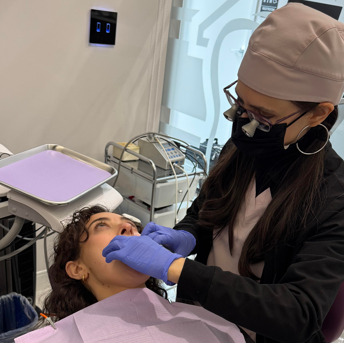
Dr. Shaindy Silverstein D.D.S. On Why Saving Your Natural Tooth Should Still Be the Priority in Modern Dentistry
Root canals have one of the worst reputations in dentistry. For many patients, the phrase alone creates anxiety. But according to endodontist Dr. [Name], much of that fear is outdated — and in many cases, unnecessary. In this interview, she shares why she chose endodontics, why she believes saving natural teeth should always be the first goal, and what patients need to understand about modern dental technology and treatment decisions.
Dr. Silverstein is a practicing endodontist specializing in root canal therapy and facial pain treatment, including TMJ management with Botox. With advanced training from NYU and years of clinical experience treating complex cases, she has built her reputation around precision, patient advocacy, and a commitment to preserving natural teeth whenever possible. Known for combining cutting-edge technology like 3D Cone Beam imaging with a conservative, ethics-first philosophy, she believes dentistry should prioritize long-term patient health over convenience or trend.
Thank you so much for joining us. To start, can you tell us a bit about your background and how you chose this path?
I always knew I wanted to go into medicine. Ever since I was a child, I wanted to be a doctor. Dentistry felt like the best of both worlds for me. I enjoy working with my hands, I enjoy helping people, and I liked that it wasn’t always life-or-death situations. I could focus on precision and craftsmanship while also making people feel confident about their smile.
What led you specifically to specialize in endodontics?
During dental school, I realized how tooth pain can be one of the worst pain in the whole body. Patients who need a root canal are often in excruciating pain. I liked the idea that I could take someone who is a ten out of ten in pain and help them quickly — often in one or two visits. That felt meaningful to me.
For readers who may not be familiar, what exactly does an endodontist do?
Most people don’t even know what the word “endodontist” means. “Endo” means root. We are root canal specialists. Our job is to diagnose tooth pain and treat infections inside the root of the tooth, while preserving the natural structure whenever possible.
You’ve spoken about the importance of preserving natural teeth. Why is that such a central part of your philosophy?
A good endodontist genuinely tries to save the tooth at all costs. When we talk about saving a tooth, we mean preserving the patient’s original root structure. Once you extract the tooth and remove that root, you can never get it back. An implant is a screw that replaces the root. It’s a great solution when necessary, but it’s still a replacement. If you were my family member, I would want to do everything possible to preserve your natural tooth first.
In your experience, what are the top five things patients should understand before deciding between saving a tooth and extracting it for an implant?
Your natural tooth is almost always worth trying to preserve. Nothing functions exactly like the tooth you were born with.
Implants are excellent when necessary — but they are still artificial. They require surgery and ongoing maintenance.
Many teeth that seem “hopeless” can be saved with the right expertise and technology.
Once a tooth is extracted, the decision is permanent. There’s no reversing that choice.
Motivation matters. If a patient is motivated to save their tooth and understands the process, outcomes are often very successful.
Technology has advanced significantly over the last decade. How has that changed your ability to save teeth?
The biggest advancement is 3D Cone Beam imaging, or CBCT. I tell patients it’s like an MRI for your tooth. Traditional X-rays are two-dimensional and can sometimes be misleading depending on the angle. With CBCT, I can see everything in three dimensions — the length of the roots, hidden infections, fractures, anatomy. That level of accuracy allows me to make better decisions and avoid unnecessary treatment.
Can you share an example of how that technology made a difference?
I had a patient who was told she had an infection. She didn’t feel pain and didn’t want unnecessary treatment. I took a CBCT scan and confirmed there was no infection — it was just an artifact on the traditional X-ray. Without that technology, she may have undergone treatment she didn’t need. Accuracy protects patients.
Root canals are often feared. What would you say to someone who is anxious about the procedure?
The infection is painful. The procedure itself should not be. I tell every patient that I will not work on them unless they are completely numb. If they feel pain, I stop. Most of the fear comes from outdated experiences. Modern techniques and anesthesia have changed that.
You also treat TMJ and facial muscle pain. How does that fit into your practice?
Many patients come in thinking they need a root canal, but their pain is actually muscular. Stress causes people to grind and clench their teeth, which tightens the masseter muscles — the chewing muscles. That tension can mimic tooth pain. In many cases, targeted Botox injections into those muscles relax them and relieve the pain. While some patients notice cosmetic benefitsas well, my focus is always functional relief.
What is your overall message to patients?
Less is more. Every time you drill a tooth, you remove structure. Fillings can lead to root canals. Root canals lead to crowns. Crowns eventually need replacement. So we have to be thoughtful. Preserve what you were born with whenever possible. Seek second opinions if you’re unsure. And choose providers who are motivated to do what’s best for you.
About the Interviewer: Chad Silverstein is a seasoned entrepreneur with 25+ years of experience as a Founder and CEO. While attending Ohio State University, he launched his first company, Choice Recovery, Inc., a nationally recognized healthcare collection agency — twice ranked the #1 workplace in Ohio. In 2013, he founded [re]start, helping thousands of people find meaningful career opportunities. After selling both companies, Chad shifted his focus to his true passion — leadership. Today, he coaches founders and CEOs at Built to Lead, advises Authority Magazine’s Thought Leader Incubator.