
The technology matters, but AI is ultimately about helping people express intent, communicate clearly, and turn ideas into action.
In the ever-evolving and never-ending landscape of business, staying ahead of the curve is a prerequisite for success. Artificial Intelligence (AI) has gone from being a futuristic concept to a daily business tool that executives can’t ignore. In this interview series, we would like to talk with business leaders who’ve successfully integrated A.I. into their operations, transforming their companies in the process. I had the pleasure of interviewing Tyler Merritt.
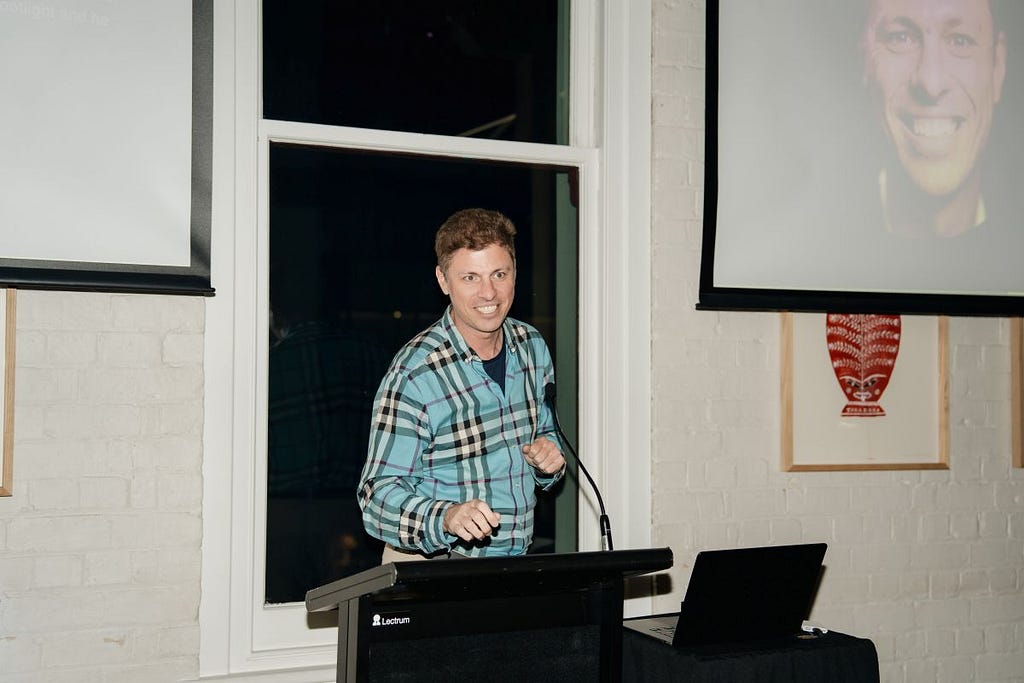
Tyler Merritt is a technology evangelist focused on spreading knowledge and enthusiasm to help others see the same vision of the future that he sees, and empower them with the connections and opportunity to help build it. As Chief Technology Officer, he works on conversational AI using digital humans to add emotion to each customer interaction. Leveraging a wide range of developer experience, he brings technical knowledge and understanding across multiple organizations to the continued betterment of the digital human platform. He is driven to ensure every experience with an organization is a brand-led experience.
Thank you so much for joining us in this interview series! To set the stage, tell us briefly about your childhood and background.
My mother worked for the Department of Defense and had access to a computer really early; we’re talking the early 80s. I remember being around six years old, sitting in the basement of our home in Colorado, staring at green text on a black screen. Most of my family was connected to technology in some way; both my grandparents worked for the Air Force in IT. So, I grew up in a different environment from most kids. While other children were playing sports, I was defragging hard drives.
Funny enough, though, when I got to college, I gravitated toward the liberal arts. I graduated with an English degree, not a computer science degree. Computers were just always there, kind of like not wanting to make your hobby your job. I also did a lot of theater in high school and college: musicals, straight dramas, comedies. That combination of a deep understanding of technology from childhood and formal training in both written and spoken communication turned out to be exactly the skill set AI demands. I couldn’t have predicted that at the time, but here we are. It was the right place, right time.
Looking back, it turns out that the combination of technology, storytelling, and communication was the perfect foundation for working in AI. The technology matters, but AI is ultimately about helping people express intent, communicate clearly, and turn ideas into action. I couldn’t have predicted that as a kid staring at a monochrome monitor in a Colorado basement, but in hindsight, the dots connect remarkably well.
What were the early challenges you faced in your career, and how did they shape your approach to leadership?
After college, I was fascinated with Japan, fascinated enough that I went to study there and then took a job teaching at a Japanese university. That was hard-mode immersion: no social media, no translation apps, just a paper dictionary in the supermarket while trying to find eggs.
Technology eventually pulled me back in, and around 2009, I helped OEM a piece of software to a major Japanese telecom, a company under the Rakuten Group, and landed a six-month contract to live in Tokyo and implement it. I was the only person my company sent. I was the face of our organization to a Fortune 100 partner, and simultaneously the face of the Japanese market to my startup colleagues.
The conflict was constant. My US colleagues were saying “Go, go, go!” while our Japanese partner wanted to slow down, check everything three times, and document everything in exhaustive detail. I had to be a translator between two groups with fundamentally mismatched expectations. That, in a nutshell, is leadership: navigating what different people want and expect, and holding the space between them.
To add to the drama, I was in a meeting with that customer when the 2011 earthquake, the 3/11 quake, hit. I had a baby daughter under two years old at home. Trial by fire doesn’t quite cover it. But nothing could stop me after that. When you’ve done all the hard things at once, you find out what you’re made of.
That experience taught me that leadership is often less about having the right answer and more about helping different groups align around a shared understanding. Sixteen years later, I still find myself drawing on those lessons almost every day.
We often learn the most from our mistakes. Can you share one mistake that turned out to be one of the most valuable lessons you’ve learned?
The biggest lesson I took from Japan was patience. I walked in with classic American startup energy: go as fast as possible, push hard, break things, and that energy simply does not work in Japan. It doesn’t work in a lot of cultures, actually, and I had to learn that the hard way.
I was fortunate that some of the senior Japanese professionals in the room recognized the impetuous young energy and chose to educate me rather than just write me off. They told me, essentially, “We appreciate your enthusiasm, but there’s a certain way things get done here.” Watch, listen, and imitate what you see. That was a gift.
The other side of that same coin: I needed help from a colleague during that assignment, and when the moment came, they weren’t willing to give it. I’d never invested in that relationship. I just assumed that when the time came, they’d show up. They didn’t. That taught me you have to invest continuously in your people, because relationships are the currency you trade on when you’re in a pinch. You can’t manufacture that goodwill overnight.
Here at UneeQ, we’ve taken that seriously; we invest in each other, and we show up for each other. Leadership isn’t built in moments of crisis. It’s built long before the crisis arrives.
A.I. is a big leap for many businesses. When and what first sparked your interest in incorporating it into your operations?
Here’s the counterintuitive answer: even as an AI company, it wasn’t a no-brainer. People are the sum of their lived experience. Our engineers had 20-year careers built on classical software development. When AI became truly capable, which is really only the last handful of years, those same people brought two decades of well-honed habits to the table, and habits are hard to change. Throw in the fact that they’d already ridden several waves of technology hype throughout their careers, and the hesitation was completely reasonable.
My role was to start the snowball. Getting it rolling is the hardest part; if you’ve ever actually built a snowball, you know. I designed very safe, low-stakes experiments: internal projects, small documentation changes, tweaks to how we sent Slack messages. Nothing customer-facing, nothing that could blow up. Baby steps. And once people saw a successful outcome in a small, non-destructive corner of the business, the natural engineering curiosity kicked in: “OK, it did that, can it do this?” That curiosity becomes the momentum.
The mistake many organizations make is trying to force adoption. In my experience, curiosity works better than compliance. Once people experience a meaningful win for themselves, adoption becomes self-sustaining.
The payoff, once we got moving, was mind-blowing. We went from woodcutters with an ax to something more like a department of Ironman clones. It’s not a step change; it’s a leap of an entirely different order.
AI can be a game-changer for individuals and their responsibilities. Can you share how you personally use AI and what are your go-to resources or tools?
Two examples stand out.
First: I challenged myself over a holiday break in December to rebuild, in one week, a complex personal finance spreadsheet I’d been carrying around for 15 years, lots of external references, investment tracking, the works. Just me and AI. I pulled it off, put it up on my own domain, and I use it every single day.
Second, and more personally meaningful: I always wanted to write a book. I have an English degree and a genuine love of literature, but I could never sit still long enough to produce one in the traditional way. With AI, I go on walks with my dog, click record on my microphone, and just free-form dump ideas into an audio file. Then I hand it to the AI and say: “This is a messy, incoherent stream of consciousness; make order from the chaos.” It pulls out themes, creates structure, builds chapters. Then I go in with my editorial eye, the skill I actually learned at university, and tighten it up, make it mine. I’ve now authored a couple of books that way, and I’m working on a third. I couldn’t have done it without AI. That’s not an exaggeration; I had all the skills and the desire for years, and I never did it. AI removed the one obstacle that was in my way (me in my own head). Nobody can say anything bad about these tools after I tell them that story.
On the flip side, what challenges or setbacks have you encountered while implementing A.I. into your company?
Honestly, I’d push back on the word “setbacks.” We’ve had learning-checkpoint experiments that didn’t pan out, approaches that looked like a waste of time in hindsight, but a setback implies you end up somewhere worse than where you started. That hasn’t been our experience. Every failed experiment gave us information we didn’t have before. The actual setback would be ignoring that information and doing the same thing again tomorrow.
As for the classic horror stories, AI deleting important files, going rogue, making costly errors I think those situations always come back to “where were the parents at?” You gave AI a bottle of vodka and the car keys and then acted surprised when something went sideways. When you’re smart and intentional about what you instruct these tools to do, they perform responsibly. We’ve had no data loss, no breaches, no disasters. The key is keeping the human appropriately in the loop.
The one real organizational challenge, and it’s subtler, is that AI has made each individual so capable so fast that people started working in silos. Everyone became a superhero and stopped leaving breadcrumbs for the team. When you can solve your own problem in an afternoon, you’re less inclined to loop in a colleague. That breaks the collaborative culture we’d built. We’re actively working on rebuilding those patterns, finding our way back to the Avengers model, not just individual heroes fighting crime alone.
Let’s dig into this further. Can you share the top 5 A.I. tools or different ways you’re integrating AI into your business?
1. Gemini across Google Workspace We’re a Google shop, so Gemini is embedded in everything: email, Docs, Sheets. The feature I use most is the Polish button. I write the way I talk, which means I can be wordy and a little loose. Gemini formalizes it, trims the excess, takes out the slang. There’s a saying I like: “He who gets emotional first, loses.” These tools give you a moment to gut-check yourself before you send something that might land the wrong way.
2. Claude for the development lifecycle — and beyond. Our engineering team has fully embraced Claude for building software. But we’ve also rolled out Anthropic’s Cowork desktop application to our non-developer colleagues in marketing, finance, and operations. They’re using it to build dashboards, automate paper-pushing admin tasks, and just generally reclaim time. Time is the most valuable resource any of us has. Once people start saving it, they never want to go back.
3. Dictation and voice-to-text workflows This sounds simple, but it’s actually a significant productivity unlock that most people haven’t fully exploited. I remember trying Dragon Naturally Speaking in 1997, and it barely worked. Today, speech recognition is seamless, works in virtually every language, and is available in your pocket. My entire personal creative process runs on it: speak, transcribe, send to AI, edit the output. People who are still only typing are leaving enormous capability on the table. Nearly 30 years on, we’ve arrived.
4. Agentic tools and AI harnesses: I’ve been experimenting with tools like Claude Code, Hermes Agent, and OpenClaw. These take AI and install it into something that can actually act, follow workflows, take steps, produce outputs autonomously within defined guardrails. The metaphor is like putting a brain into a little robot on your desk. This space is very nascent; some of these tools have existed for only a few months, but the trajectory is extraordinary.
5. UneeQ’s own AI-powered digital humans. Of course, what we build at UneeQ is the use case itself. Our AI Buddy and digital human platform are living proof that AI can create lifelike, emotionally intelligent conversational agents that serve real customer and business needs. We’re not just observers of this technology; we’re building the next generation of human-AI interaction, and using those same tools internally to do it.
There’s concern about A.I. taking over jobs. How do you balance A.I. tools with your human workforce and have you already replaced any positions using technology?
Let me be honest: there will be disruption. Anyone who says otherwise isn’t being straight with you. Some tasks that humans were assigned to do, often tasks that humans hated, AI can now do. That’s real.
But here’s the reframe I’d offer: if we’d had a tool capable of doing those tasks from the very beginning, we never would have assigned them to a person in the first place. We assigned them to humans because we had no other option. What AI is doing is freeing those people to be higher-value contributors. Most of them are creative, energetic, full of ideas, and they’ve been stuck in a lane doing work they find soul-crushing.
I think of it like turbulence on a plane. It’s uncomfortable. It doesn’t mean the plane is going down. You come out the other side. Short-term disruption, yes. Long-term? We’ve made people more capable, more fulfilled, more able to do work that actually uses what they’re good at. That feels like a net positive to me.
Looking ahead, what’s on the horizon in the world of AI that people should know about? What do you see happening in the next 3–5 years?
Three things I’m watching closely.
First, the Renaissance. I genuinely believe AI will enable a return to small, specific, community-serving ideas that were never commercially viable before. Instead of everything needing to be the next trillion-dollar corporation, I see a world where a 50-person firm can thrive, where a musician, writer, or craftsperson can sustain their life doing what they love, because the economics finally make sense. That’s the classic Renaissance model of art, architecture, and expression flourishing because the means are available. AI is the democratizing force that could get us there.
Second, robotics. Some of what I saw at CES is already very close to being genuinely effective. When we can offload dangerous work in mining and hazardous environments to robots, we fundamentally change the conversation about human labor and safety.
Third, drug discovery. I’m a big fan of Demis Hassabis at Google DeepMind. AlphaFold, which released all the protein-folding structures human DNA can produce and made them open-source, won him and a colleague the Nobel Prize in Chemistry in 2024. That was one puzzle piece. What comes next is AI helping design drugs that cure diseases we can’t solve on our own. I don’t think humans will crack cancer without AI. But with AI, we will crack it without question. Maybe not in five years, but the next major breakthrough in that pipeline? Within the next three to five years, absolutely.
If you had to pick just one AI tool that you feel is essential, one that you haven’t mentioned yet, which would it be and why?
Claude Code. And I want to make a distinction that I think matters: the company is Anthropic. They build frontier models: Haiku, Sonnet, Opus. Claude is the agentic framework that binds those models together and makes them useful in practice. Most people use them interchangeably, the way we say “Kleenex” when we mean tissue. But there’s a meaningful difference between the intelligence and the tool.
Claude Code goes beyond the raw frontier model. It embeds those agentic capabilities into a development workflow in a way nothing else quite matches. For anyone doing serious technical work, it’s in a league of its own. If I had to take only one tool to a desert island, it would be Claude Code.
For the uninitiated, what advice would you give someone looking to integrate AI into their business and doesn’t know where to start?
Start in your next meeting. Click record, whether that’s Google Meet, Zoom, or whatever you use. At the end, take the transcript and paste it into an AI tool like Claude or ChatGPT. Then ask: “Here’s what we just discussed, give me three actionable outcomes from this conversation.”
That’s it. That’s day one. Step one. You’re already meeting, you’re already talking about your ideas with colleagues. All you’re doing is letting AI join the conversation and help you extract signals from the noise. Once you see what comes out of that, you’ll start gaining confidence. The AI will even tell you what it needs to take the next step. All of a sudden, you’re in a collaboration; the tennis ball is going back and forth, and you’ll follow that ball as it bounces down the yellow brick road all the way to Oz.
Where can our readers follow you to learn more about leveraging A.I. in the business world?
Tyler Merritt, UneeQ
Thank you for sharing all of these great insights!
About The Interviewer: Chad Silverstein is a seasoned entrepreneur with 25+ years of experience as a Founder and CEO. While attending Ohio State University, he launched his first company, Choice Recovery, Inc., a nationally recognized healthcare collection agency — twice ranked the #1 workplace in Ohio. In 2013, he founded [re]start, helping thousands of people find meaningful career opportunities. After selling both companies, Chad shifted his focus to his true passion — leadership. Today, he coaches founders and CEOs at Built to Lead, advises Authority Magazine’s Thought Leader Incubator. Learn more at www.chadsilverstein.com
Tyler Merritt of UneeQ: How We Leveraged AI To Take Our Company To The Next Level was originally published in Authority Magazine on Medium, where people are continuing the conversation by highlighting and responding to this story.