
An Interview With Chad Silverstein
Money is like oxygen. Too little will kill you, but too much can kill you too.
In the ever-evolving and never-ending landscape of business, staying ahead of the curve is a prerequisite for success. Artificial Intelligence (AI) has gone from being a futuristic concept to a daily business tool that executives can’t ignore. In this interview series, we would like to talk with business leaders who’ve successfully integrated A.I. into their operations, transforming their companies in the process.
As a part of this series, we had the pleasure of interviewing Amir Mansouri.
Amir Mansouri, PhD, is the CEO and Co-founder of SprintRay. Before founding SprintRay, Amir received both a Master’s degree and PhD in the field of additive manufacturing. A unique blend of scientific and entrepreneurial, he pursued a technology commercialization program at USC Marshall School of Business, which led to the co-founding of SprintRay in 2014. Under his direction, SprintRay has grown from a proof-of-concept business plan to a multi-national company with more than $100M in revenue last year.
Thank you so much for doing this with us! To set the stage, tell us briefly about your childhood and background.
I grew up in Iran which had its own rights, benefits, and limitations. Childhood for me often included chasing a soccer ball. That is what I was doing all the time in the streets. I was also the kid who liked to take things apart to see how they worked, and rebuild them, and that mindset was a key driver in why I became an engineer.
As I went through high school, the system in Iran is structured. If you are very smart, you either become a doctor or an engineer. Those are the two paths. My parents pushed me toward engineering, which was a very structured path. I didn’t know if I liked it at first, but as I invested more time, it quickly became my passion.
Growing up in a third-world country had limitations, but it also had its own rights and benefits. At some point, the limitations got too big, and kudos to my parents. They pushed me to think big, to cross a bigger ocean, and to find a college where I would be able to grow faster. I always wanted to come to America. It was my dream, inspired in part by Hollywood movies, and my ambition to build something of my own.
I ended up at USC doing a PhD in manufacturing engineering, and that changed my life. By complete serendipity, I landed in a lab working on NASA projects where we were building 3D printers to be used by astronauts on the surface of the moon. It was a surreal experience. Having grown up in Iran, I had never even left the country, and the first thing I am doing is working on a project to 3D print lunar simulants. My experience at USC changed my perspective and desire in my career to build something that was truly transformational.
I worked on a lot of NASA-related projects during my PhD. Toward the end of that time, I became increasingly entrepreneurial. I wanted to start my own company, or at least give it a real shot, before joining a larger organization or taking a traditional job. I was drawn to the idea of building something from the ground up that could have real world impact.
We put together a prototype of a high-resolution 3D printer using the same core principles we were exploring for printing on the surface of the moon. At some point, a simple question came up: if we can print with this level of precision in extreme environments, why can’t we apply it to something closer to home? We didn’t know it at the time, but that question eventually led us to found SprintRay, which would transform the dental space.
In most industries, efficiency comes from mass production. Cars, clothing, and electronics are built to serve many. Dentistry is different. Every patient’s mouth is unique, and every restoration is made for one person. That makes dentistry uniquely suited for 3D printing and mass customization.
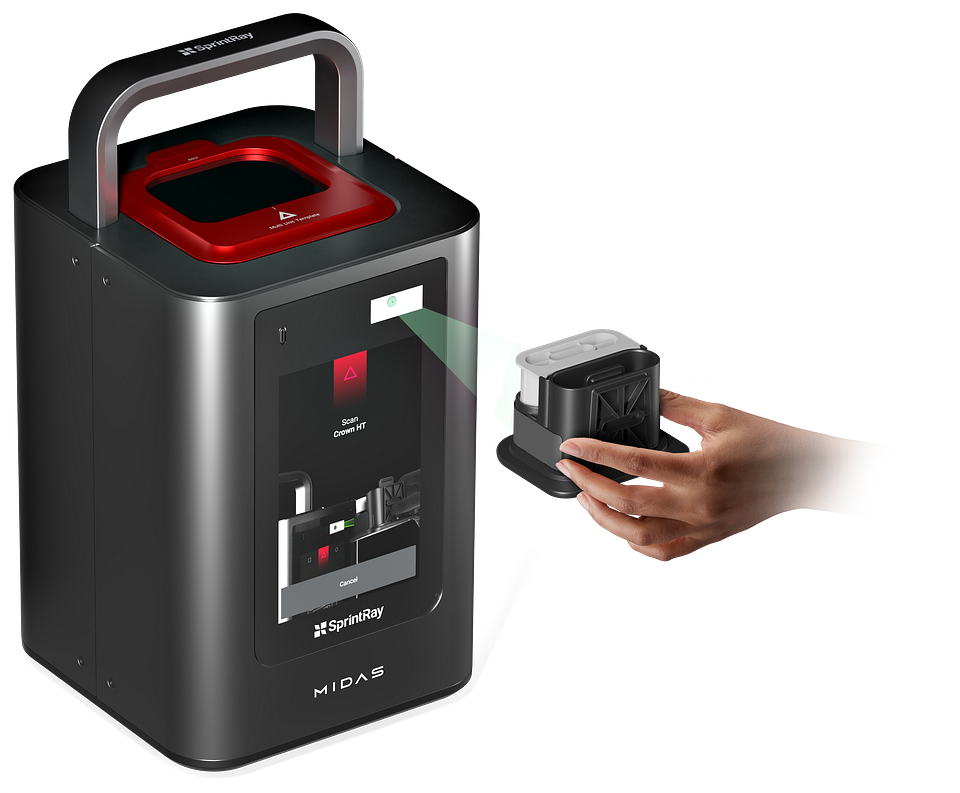
That realization became the foundation of SprintRay. Today, the company holds 55% of the U.S. chairside 3D printing market and has powered more than 600,000 patient treatments worldwide. What began as an academic project at USC evolved into a company built on the belief that advanced manufacturing can fundamentally change how dental care is delivered. SprintRay’s flagship Midas platform now compresses multi-week workflows into a single visit, enabling dentists to print up to three definitive crowns in 10 minutes and complete full restorations in as little as 30.
What were the early challenges you faced in your career, and how did they shape your approach to leadership?
I was always entrepreneurial growing up. Even in my teenage years, I was always good at trading things, buying, selling, and flipping things. But I didn’t know the culture when I moved to the U.S. from Iran, or how to build a team, grow a team, or scale a team.
The challenges I faced were typical for a first-time tech entrepreneur, not understanding the fundamentals of business. You have to brute-force your way through fundraising, leadership, and bringing in the right people. Then the business starts to outgrow your leaders and your team, and you hit inflection points where you have to upskill or upgrade the people around you. Over the years, I joke that I earned a few MBAs just by doing and learning through the process.
The biggest challenge in building a fast-growth company from the ground up is that every two years you will hit a major inflection point where your business is outgrowing your people. Some people can move at that pace and reinvent themselves, and some cannot. I have had no choice but to reinvent myself every six months as well. I do that by surrounding myself with high-caliber leaders, bringing in experienced advisors and thought leaders to analyze the business. I’ve also learned the importance of having strong board members and advisors.
But one of the hardest challenges for any founder is building the right team. Not everyone has a growth mindset, or they have a tendency to stay comfortable where they are. So every six months, you have to reevaluate talent on your team and continually make changes and evolve. Building the right team means constantly encouraging, inspiring, and developing people. It also requires being willing to act or make changes when someone isn’t growing at the pace the company requires.
We often learn the most from our mistakes. Can you share one mistake that turned out to be one of the most valuable lessons you’ve learned?
As an entrepreneur and leader, you have to be comfortable making bold decisions. At best, your batting average is maybe fifty percent. What you cannot afford to do is avoid making decisions altogether. You have to place bets, change direction, and take risks. But just as important as jumping is knowing how to navigate once you do, observing what works, and pivoting when needed.
One of the most valuable lessons came after SprintRay raised a significant amount of capital in 2022. When you suddenly have a lot of money in the bank, it’s easy to lose focus on your priorities. Money is like oxygen. Too little will kill you, but too much can kill you too. We overhired, overspent on marketing and sponsorships, and pursued growth at all costs. Looking back, many of those decisions weren’t the right ones. That was a big lesson for me… how to grow responsibly. You have to have a profitable business model from day one, and then invest in growth deliberately.
We course-corrected quickly. We shifted from burning cash to focusing on profitability and steadily growing the business and results speak for themselves. Today SprintRay is the leading 3D printing company in the dental space and profitable with more than $100 million in revenue per year.
My early experiences as a co-founder taught me to be cautious of the venture capital treadmill where founders are pushed to raise, burn, raise, and burn again. That cycle often benefits investors more than entrepreneurs. Together with my team we double down on our focus to become the leading 3D dental printing company in the world and that focus continues to pay off and differentiate us from competitors.
Entrepreneurs overestimate what they can do and invest in too many initiatives, spreading thin. The ability to cut through the noise and focus on one or two things that matter that quarter, that year, has been very successful for me.
A.I. is a big leap for many businesses. When and what first sparked your interest in incorporating it into your operations?
We jumped into AI very early, and honestly, we burned a lot of money at first without seeing real results. In the beginning, it felt like a gold rush. Everyone was experimenting with AI, including us. We invested in teams and tools to automate operations, but many of those early efforts didn’t deliver.
Over the past two years, the AI space has matured dramatically. Solutions have become more practical and easier to integrate. Today, we use AI to automate our business operations, not just writing emails. For example, we use it for scheduling training calls, handling inbound requests, routing customer questions, and supporting sales workflows. Tasks that once required entry-level staff can now be handled by AI.
That said, the infrastructure is still fragile. Systems break, outages happen, and human oversight and intervention is still required daily. Some AI implementations have even turned out to be more expensive than hiring people. So while we’ve made progress, I would say we’re maybe thirty percent of the way toward where AI can really be.
AI can be a game-changer for individuals and their responsibilities. Can you share how you personally use AI and what are your go-to resources or tools?
In addition to drafting emails, I use AI primarily as a sounding board. I spend a lot of time using voice prompts and talking through ideas. I’ll ask it to think like a management consultant at Mckinsey to advise me on a business problem, or to think like a product leader or a marketing strategist and challenge my thinking.
That is how I use AI daily and many of the ideas we’ve implemented at SprintRay, including team changes and product strategy shifts, started as conversations with AI. It helps me stress-test decisions quickly and see blind spots. Personally, I feel ten times smarter using AI because it connects me to a broader world of knowledge and perspectives. I don’t want to go back to the pre-AI days.
At the same time, AI is only as good as the context and prompt you create. How much you rely on AI really comes down to your approach and your willingness to experiment with your team to stretch further.
There is a lot of buzz around AI agents, but much of that is overhyped. The productivity of AI agents today is probably just 10–30% of what is promised. It is still too expensive and still has a long way to become standardized the way we use Salesforce or Google Docs.
On the flip side, what challenges or setbacks have you encountered while implementing A.I. into your company?
The biggest challenge is that there is no standard system. 2025 was a breakthrough in terms of tools, but if you want to build a true agent that connects different platforms, there is still nothing that does it well without being overly expensive.
Software-as-a-Service transformed corporate productivity, but it also created inefficiency. At any given time we are using Google, Slack, an ERP, a CRM, order processing, and e-commerce platforms. If you want to automate business operations, you have to connect all of these using agentic AI, and there is no reliable standard system to do that. Large vendors try to lock you into their ecosystem, and startup tools are often fragile and do not scale.
In reality, agentic AI today is about stitching together disconnected SaaS platforms. As much as SaaS made us productive, it also forced us to jump from one tool to another. Even something as simple as scheduling meetings still requires third-party tools that make mistakes and require human intervention. Until these systems become unified and reliable, AI-driven automation will remain imperfect.
Let’s dig into this further. Can you share the top 5 A.I. tools or different ways you’re integrating AI into your business? What specific functions do they serve and what kind of result have you seen so far? If you can, please share a story or example for each.
We use AI in several ways across our business including:
1. Workflow automation
we use AI to automate workflows. As information comes in via email, chat, calls, or messages across different systems, AI helps us to processes it, decides on an action, or route it appropriately. We also use it for supply chain and communications workflows, receive this, send that, tasks that used to require entry level staff.
2. Business operations
We use Lindy AI as a way to connect silos and automate workflows across tools. A basic example is scheduling training calls. A request comes in and the training is scheduled without a person doing it.
3. Sales and customer support
We use AI to schedule training, answer product questions, qualify customer interest, and route leads to sales when appropriate. Customers email, call, text, or chat with product questions like does your machine do A, B, and C. If the AI detects the customer is ready, it schedules them with a sales rep for a demo.
4. Customer engagement and retention
We also have an agent that looks at customer usage data. If usage drops, it reaches out and offers a call with a specialist to help. If a customer is on an older platform and we see from data they already had ROI, it reaches out and says it is time to upgrade and tries to schedule them with a sales rep.
5. Product development
On the product side, AI plays a critical role for SprintRay. When a dentist uploads a case with a missing tooth, our system proposes a crown design that matches the patient’s anatomy, contact points, and bite dynamics in seconds. We built our own proprietary models to automatically generate these designs from 3D scans, removing one of the biggest barriers to chairside adoption, which was the complexity of CAD design traditionally handled in a lab. What used to require weeks of lab work, shipping impressions back and forth, and multiple patient visits can now be scanned, designed, printed, and delivered in less than 30 minutes with SprintRay. A crown, inlay, onlay, flipper, or night guard can also be scanned and produced in a single appointment.
There’s concern about A.I. taking over jobs. How do you balance A.I. tools with your human workforce and have you already replaced any positions using technology?
There is always concern that AI will take over jobs, but my view is more practical. AI will replace people who refuse to use it, or try to block the sun with one finger, but not people who learn how to leverage it.
AI is powerful both as a sounding board and a force multiplier and the people who embrace it, learn how to prompt it well, and apply it to their daily work will be more productive and more valuable. In fact, they are also probably more likely to get promoted, make more money, and make better decisions in their jobs.
The smart question for leaders to ask is not whether AI will replace them, but which parts of their role are uniquely human and which parts are repetitive. AI is excellent at streamlining workflows, synthesizing data, spotting patterns, and handling simple tasks. That frees people to focus on higher-level thinking, whether that’s developing creative ideas, strategy, or designing a new product or service, which are the things that truly drive value.
Looking ahead, what’s on the horizon in the world of AI that people should know about? What do you see happening in the next 3–5 years? I would love to hear your best prediction.
This is a tough one, but I would like to see more hardware AI. We have a lot of AI right now without hardware, and I think we will see more AI applied in the physical world. We’re already seeing it in autonomous vehicles, robotaxis such as Waymo, and robotics.
I don’t believe AI will replace most jobs in the next few years as some people fear. Instead, we’ll see humans working alongside AI-driven systems, directing them rather than being replaced by them. I would like to see more AI-driven hardware in hazardous jobs like construction, manufacturing, and logistics, where machines can reduce injuries and improve safety.
If you had to pick just one AI tool that you feel is essential, one that you haven’t mentioned yet, which would it be and why?
The next innovation is not the foundational model. It is who is going to connect these silos together. The tool I would point to is Lindy AI. I personally use Lindy a lot. It is the one that connects those silos.
For the uninitiated, what advice would you give someone looking to integrate AI into their business and doesn’t know where to start?
My advice is to roll up your sleeves, spend a few weeks experimenting with AI, and understand what it can and cannot do. Every business is different. Once you understand the basics, then bring in experts to help apply it thoughtfully. There’s no magic bullet. It takes focus, effort, and hands-on experience to maximize AI’s potential.
Every business is different. If a leader is serious, they have to immerse themselves in AI tools and start using them, and then look at hiring employees or experts to look at other specific ways it can be applied. The worst thing you can do as a business leader is respond to consultancies that reach out and say we implement AI in your business. There is no magic bullet. There is no one recipe. First you have to roll up your sleeves and explore what AI can do for your business.
Where can our readers follow you to learn more about leveraging A.I. in the business world?
Readers can follow SprintRay’s momentum on LinkedIn or our blog. You can akso follow me on my personal LinkedIn or Instagram.
This was great. Thanks for taking time for us to learn more about you and your business. We wish you continued success!
About The Interviewer: Chad Silverstein is a seasoned entrepreneur with 25+ years of experience as a Founder and CEO. While attending Ohio State University, he launched his first company, Choice Recovery, Inc., a nationally recognized healthcare collection agency — twice ranked the #1 workplace in Ohio. In 2013, he founded [re]start, helping thousands of people find meaningful career opportunities. After selling both companies, Chad shifted his focus to his true passion — leadership. Today, he coaches founders and CEOs at Built to Lead, advises Authority Magazine’s Thought Leader Incubator.
Amir Mansouri Of SprintRay: How We Leveraged AI To Take Our Company To The Next Level was originally published in Authority Magazine on Medium, where people are continuing the conversation by highlighting and responding to this story.